It is impossible to talk about today’s labour market without mentioning artificial intelligence (AI). The pace of innovation in this field is unprecedented and is already driving significant shifts, with new trends emerging rapidly.
For companies, policymakers, and educators, understanding and anticipating these changes is essential to prepare for the future of work. The AI Observatory at Politecnico di Milano has long recognised this. Founded in 2019, it brings together over 130 Italian organisations to monitor AI adoption and inform Italy’s national AI strategy.
This year, the Observatory partnered with Lightcast to shed light on AI’s impact on the labour market. You can view it here. Lightcast’s dataset – built on billions of job postings worldwide – offers a unique view of the skills employers are actively seeking. Using a methodology adopted by leading institutions, including the Stanford AI Index, it helps identify emerging trends where official statistics often lag.
AI demand on par with chefs
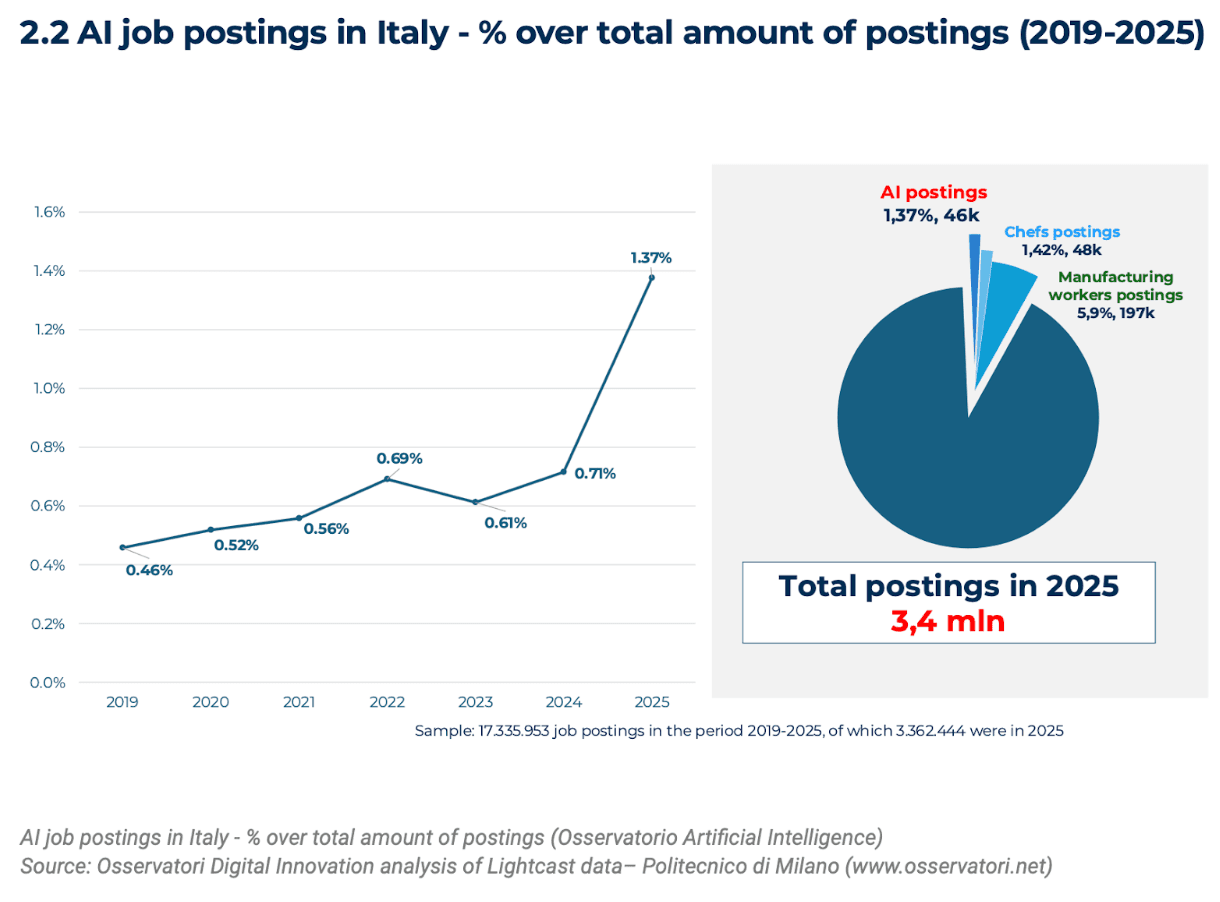
In 2025, there were 46,000 job postings in Italy mentioning AI skills, representing 1.4% of all postings. While this may seem small, it is roughly equivalent to the total number of job postings for chefs in Italy (approximately 48,000 postings over the same time period).
Looking at trends over time, demand for AI workers has grown steadily. The share of postings requiring AI skills reached 0.71% in 2024 before nearly doubling to 1.37% in 2025 — a clear signal of accelerating demand and a strengthening long-term trend. While still below high-demand occupations such as manufacturing, this rapid growth highlights the increasing importance of AI skills in the Italian labour market.
AI skills extend beyond IT
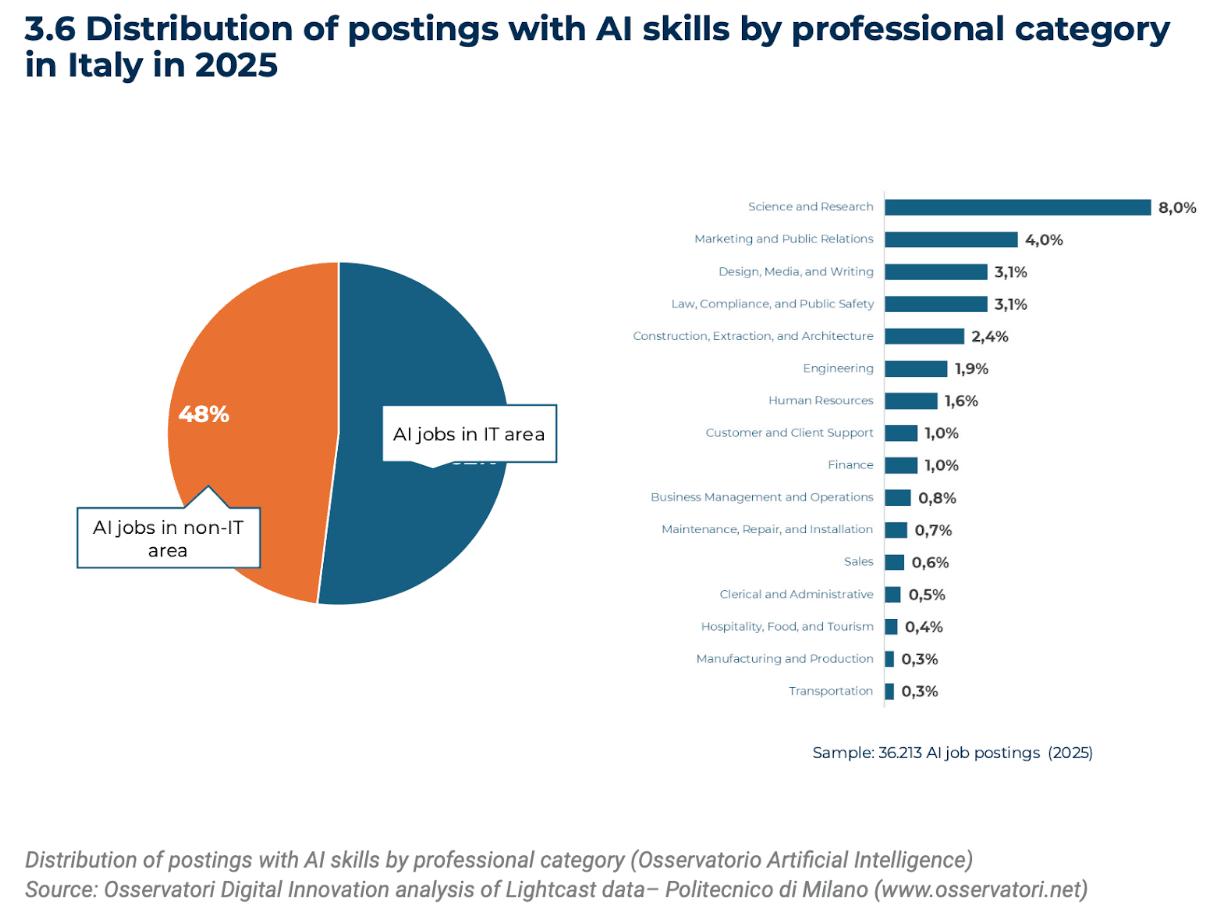
Demand for AI skills is highest in IT, but nearly half (48%) of all job postings mentioning AI skills are outside IT roles. For example, 8% of jobs in science and research require AI skills, as do 4% of roles in marketing and public relations.
This shows that AI is not just a specialised technology, but an increasingly general-purpose tool that supports productivity and work across sectors.
Opportunities across regions
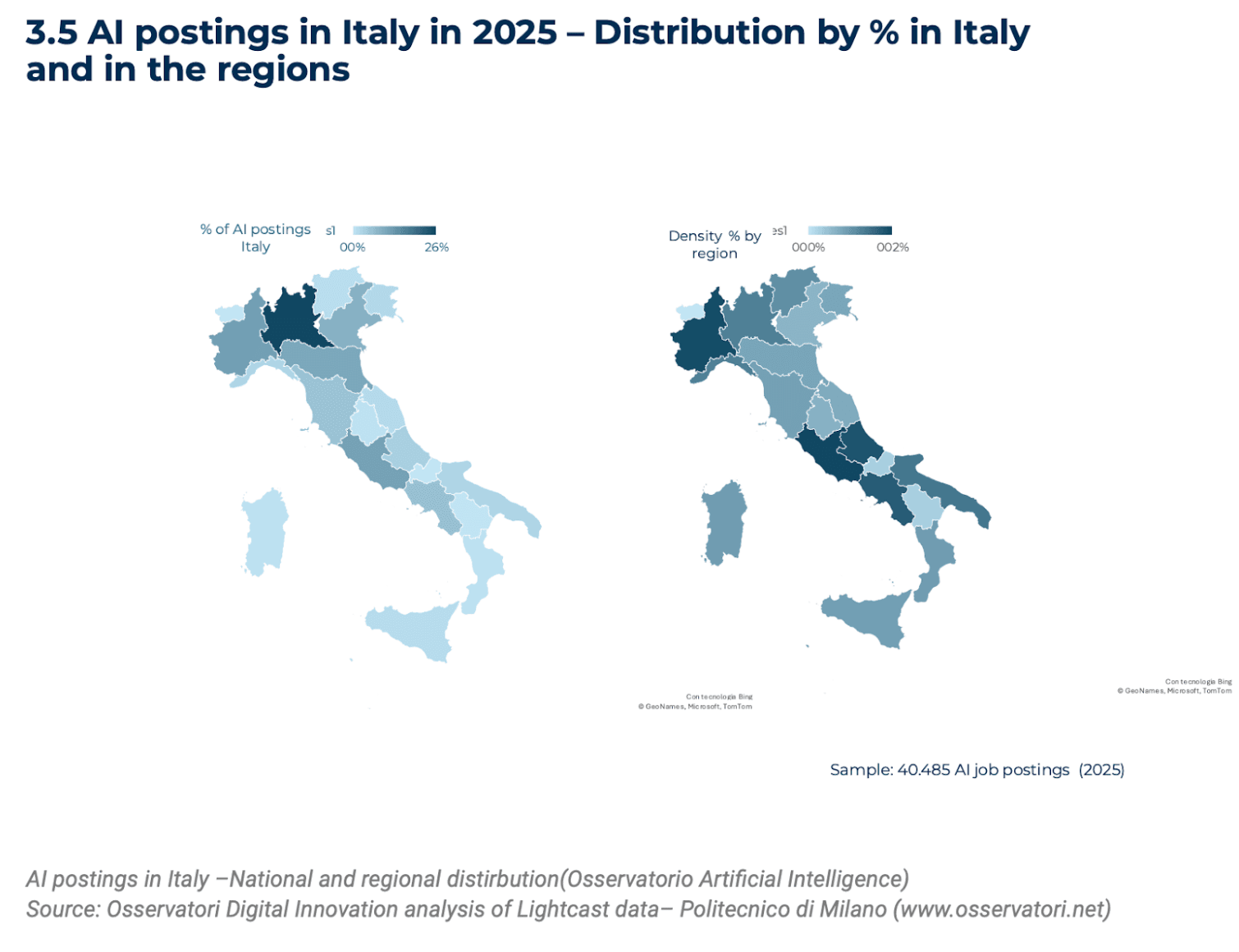
AI hiring in Italy remains concentrated in Lombardy, which accounts for around one in four AI job postings, and more broadly in the North. This is reflective of the industrial make-up of Northern Italy.
However, the picture is more nuanced when looking at regional concentration. Regions such as Lazio, Abruzzo, and Campania show above-average concentrations of AI job demand relative to the size of their labour markets.
This suggests that, rather than being a force to fear, AI also has the potential to create new opportunities across different parts of the country.
This analysis provides a snapshot of how AI is shaping the Italian labour market. However, as our broader research shows, these dynamics vary across regions, sectors, and time.
For a deeper dive, see the Stanford AI Index or Lightcast’s Beyond the Buzz report.